The Community Swap Mistake: Treating Every Offer as Useful
A clear community swap policy helps organisers accept useful offers, turn down unsuitable goods politely and avoid being left with unwanted items.
A box of chipped mugs lands beside the community hall door just as the swap is due to open. Someone has also left tangled cables, a lamp without a shade and a coat with a stuck zip. The donors meant well. The organisers now have a sorting problem, while useful items are still waiting to be checked.
The community swap mistake is treating every offer as useful because it is free. Agree what people need, what condition items must be in and who handles anything that cannot be passed on. Clear rules make it easier to welcome suitable contributions and decline the rest.
Why does accepting everything make a swap harder?
A donation is useful only if it matches a local need, is ready for someone to use and can be managed by the organisers. Picture books may suit a family centre, while a group seeking gardening tools has little use for them.
Unmatched goods take time to inspect, sort and store. A clear policy also prevents volunteers from having to find a destination for leftovers at the end of the event. The item has not disappeared; its work has simply changed hands.
What should organisers agree before collecting?
Start with the people expected to use the swap, not with whatever happens to be available. Ask potential visitors or partner groups what would help, what they can already find and which items would be difficult to store or carry.
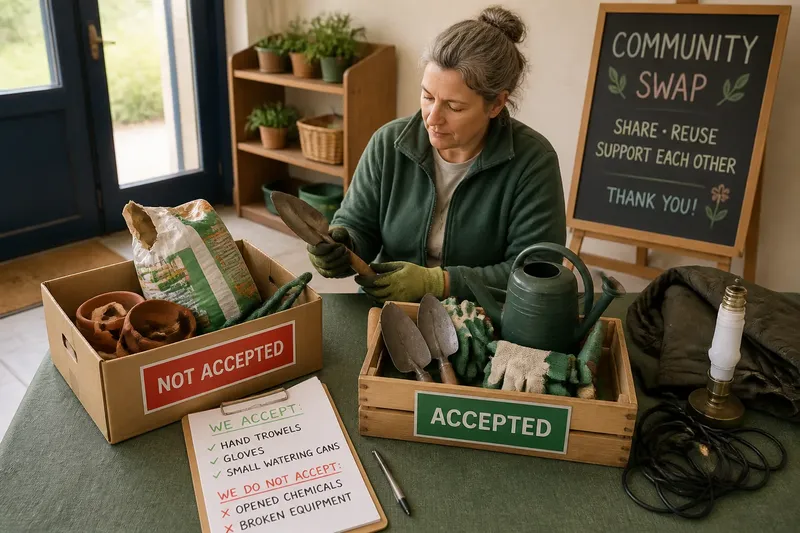
Turn those answers into a short accepted list and a short list of items the event cannot take. For a gardening swap, organisers might request reusable hand tools and clean gloves, while stating that they cannot accept opened chemicals or broken machinery.
Set a condition boundary for each category. Hand tools might need to be clean and safe to handle; fabric might need to be washable and free of strong odours. These are examples to adapt to the event, not universal standards.
For unusual or bulky offers, ask donors to send a brief description or photograph before bringing anything. This gives organisers a chance to check whether they have the space and people needed to handle it.
Which details belong in the invitation?
Put the practical rules in the notice, email or community message people will use to find the event. Include accepted categories, condition requirements, drop-off arrangements, quantity limits and what happens when an item is not accepted.
Specific wording is more useful than “bring anything useful”. “Clean, complete kitchen utensils” gives donors a clearer boundary. If organisers cannot check, store or safely distribute a category, say that it is not accepted.
Not every swap needs a new form, committee or colour-coded system. A short message and a contact for unusual offers are often enough; a spreadsheet for a few boxes of books can be more work than the books deserve.
How should organisers handle offers from arrival to handover?
Agree on a simple process before collection begins:
- Check demand. Ask intended users or local partners what they need. If there is no clear demand for a category, leave it off the accepted list or ask before accepting offers.
- Set acceptance rules. Name the categories and condition expected. If an item does not meet those rules, decline it rather than leaving the decision to a volunteer at the event.
- Screen unusual offers. Ask for a description or photograph of bulky or unfamiliar goods. If there is no space or suitable handling plan, do not arrange a drop-off.
- Inspect items at arrival. Compare each item with the published rules. If it is clean, complete and within scope, accept it; if not, return it to the donor or follow the agreed alternative.
- Make the decision clear. Tell the donor whether the item is accepted. If it is not, state who will take it away and when, rather than leaving it in a corner.
- Display accepted goods sensibly. Group similar items and provide any useful condition details. If an item’s condition is uncertain, keep it out of circulation until someone can check it.
- Resolve leftovers as agreed. Use the destination confirmed before the event, or return goods to donors if that was the arrangement. If neither route is available, do not accept the item in the first place.
Say you are organising a swap for an allotment group. The stated requests are hand trowels, gloves and small watering cans; the rules exclude opened chemicals and broken equipment. A donor brings a box with two usable trowels, a pair of clean gloves, cracked pots, opened lawn feed and a broken hose. The organiser checks each item against the list, accepts the tools and gloves, and asks the donor to take back the rest. The resulting collection matches the stated need, and the organisers have no unassigned leftovers from that box.
What if an item could suit another group?
“Someone might want it” is not a destination. Ask a possible recipient whether it accepts that category and condition, and who will transport it. A community kitchen might welcome sealed utensils but lack room for a large appliance.
For goods requiring special handling, do not improvise a route simply to avoid saying no. Follow the product label, manufacturer instructions or local disposal rules. If the safe or lawful option is unclear, ask an appropriate local service.
A group can also pass on information about an offer without taking custody of the item. If a neighbour has a sofa the swap cannot store, organisers might share the offer with permission, while making clear that they have not accepted it or promised to find a recipient.
What questions do organisers ask about community swap offers?
Should organisers accept an item if somebody may want it?
Accept it only if there is room to hold it and a realistic way to offer it. A possible future recipient does not remove the need to sort and manage the item now.
Is it rude to turn down a donation?
No, if the rules are clear and applied consistently. Thank the donor, name the relevant rule and avoid judging their intentions.
Can organisers collect first and decide later?
That can suit a small, defined collection when organisers have agreed who will sort it and where unsuitable goods will go. For a broad appeal, deciding later leaves an unresolved decision for the busiest part of the event.
What if a donor has already left an unaccepted item?
Contact the donor promptly if possible and explain what needs to happen next. If they cannot be reached, follow the event’s stated policy and relevant local rules rather than leaving the decision to an unnamed volunteer.
How can organisers keep the swap welcoming?
Make the event’s purpose visible: match what people can offer with what neighbours can use. A concise request list and clear condition rules help donors contribute without guessing what the group can manage.
After the event, note which accepted categories were taken and which remained. Use that information to adjust the next invitation. For a community swap, the exchange works best when both the offer and its conditions are understood before the goods arrive.
Before opening the next collection, ask who has agreed to handle an item that nobody takes. If there is no answer, leave that category out of the appeal. That small decision can spare the volunteers a very familiar box by the hall door.