How Neighbours Shared Skills Before Formal Workshops
Community apprenticeship passed on local skills through shared work, clear roles and careful judgement, without turning every neighbourly task into a lesson.
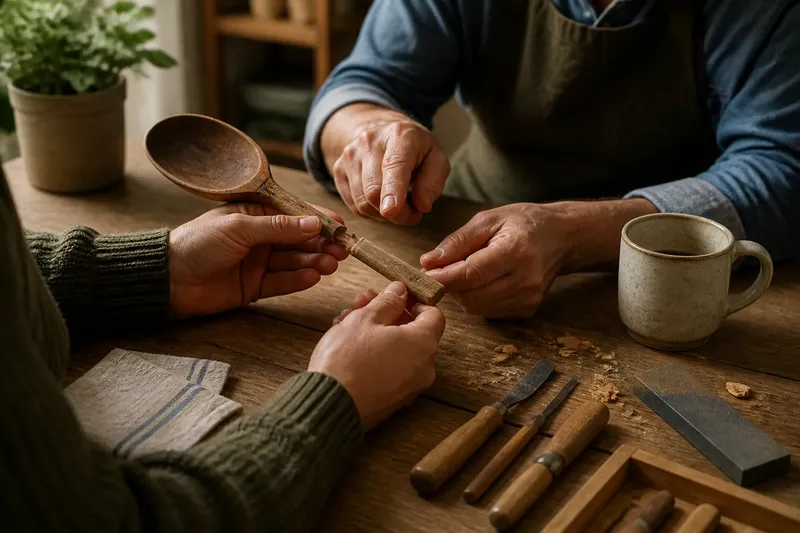
A neighbour brings a worn wooden spoon to a kitchen table, and someone who knows how to carve offers to show the repair. That small exchange is one way community apprenticeship passes on practical knowledge: through shared work, agreed roles and a clear sense of what the learner is ready to do.
Before formal workshops became a familiar route into many crafts, people often learned within households, workplaces and local networks. The arrangements varied by place and trade. Some were structured and long-term; others were informal acts of help. The useful thread is not a single historical model, but the way knowledge travelled between people who worked alongside one another.
Where did practical skills pass between generations?
Skills moved through everyday settings: a family workshop, a farm, a market stall, a boatyard or a neighbour’s home. A learner might begin with preparation and upkeep, then take on more demanding work as trust and ability developed. The setting shaped what could be taught, while the work itself supplied the reason to learn.
Not every exchange was generous or equal. Apprenticeship could involve obligations, restricted access to a trade and uneven authority. It is better understood as a broad way of organising learning than as a romantic picture of people freely sharing every skill.
What made an apprenticeship work?
Useful teaching depended on more than proximity. A craftsperson had to make decisions visible, explain why a task mattered and give the learner work suited to their ability. The learner, in turn, needed room to ask questions and a way to make mistakes without putting people or valuable materials at needless risk.
Say a neighbour asks to learn how to sharpen a garden hoe. In this invented situation, they begin with a blunt, spare tool, a file and a stable work surface. The experienced gardener explains how to secure the tool, demonstrates a few controlled strokes, then asks the learner to work on a different section while watching closely. They inspect the edge together; if it is uneven, they pause and adjust the angle before continuing. The result is a shared understanding of the task and its limits, not a claim that the learner is ready to sharpen every tool.
How did communities decide what a learner could do?
Responsibility usually grew through judgement, not a neat ladder of lessons. Someone who could prepare materials reliably might be trusted with a contained part of a larger job. A craftsperson still needed to decide when to supervise, when to step in and when a task was beyond the learner’s present ability.
For present-day community projects, a short agreement can make that boundary easier to discuss. Before work begins, clarify who owns the materials, who is responsible for the finished item and who will stop the task if something unexpected appears. For repairs involving structural furniture, electrical work or other safety concerns, use a suitably qualified person rather than treating an informal lesson as a substitute for professional judgement.
What should people ask about community apprenticeship?
Was apprenticeship the same in every trade?
No. The length, obligations and routes into work differed by craft, community and period. A household skill passed between relatives is not the same arrangement as a formal trade apprenticeship.
Did learners always pay for instruction?
Arrangements varied. Some involved fees or service, while others were part of family, workplace or neighbourly relationships. The terms matter, so it is unwise to assume that every historical learner had the same status or experience.
How can a local group share a skill fairly?
Agree on the task, materials, time and responsibilities before beginning. Make clear what the learner may do independently and who decides when the work should stop.
What is not worth the effort?
Complicated badges and elaborate progress charts are rarely useful for a small, informal exchange unless they solve a real problem of coordination or trust. A clear conversation about what someone can teach and what they are still learning is usually more practical.
How can local knowledge stay useful?
Skills last beyond one person when others can find the people, tools and places needed to learn them. A community noticeboard, a repair group or a shared workshop can connect a willing teacher with a suitable task. Keep notes on materials, decisions and limits where they help someone repeat the work, but do not mistake a written account for the judgement gained by doing it.
Community apprenticeship is most useful when it preserves both a method and the reasons for using it. The learner should leave knowing what to try, what to inspect and when to ask for help. For anyone searching for community apprenticeship, that distinction is the practical inheritance: not a promise that every old method fits every new problem, but a way to pass on knowledge without passing off uncertainty as expertise.